
Case analysis
New Mexico’s Epstein lawsuit puts a state’s civil trafficking power in focus
The October 21 complaint invokes §1595(d), a state-enforcement provision with a different statutory starting point from an individual survivor’s beneficiary claim.
Source reviewed
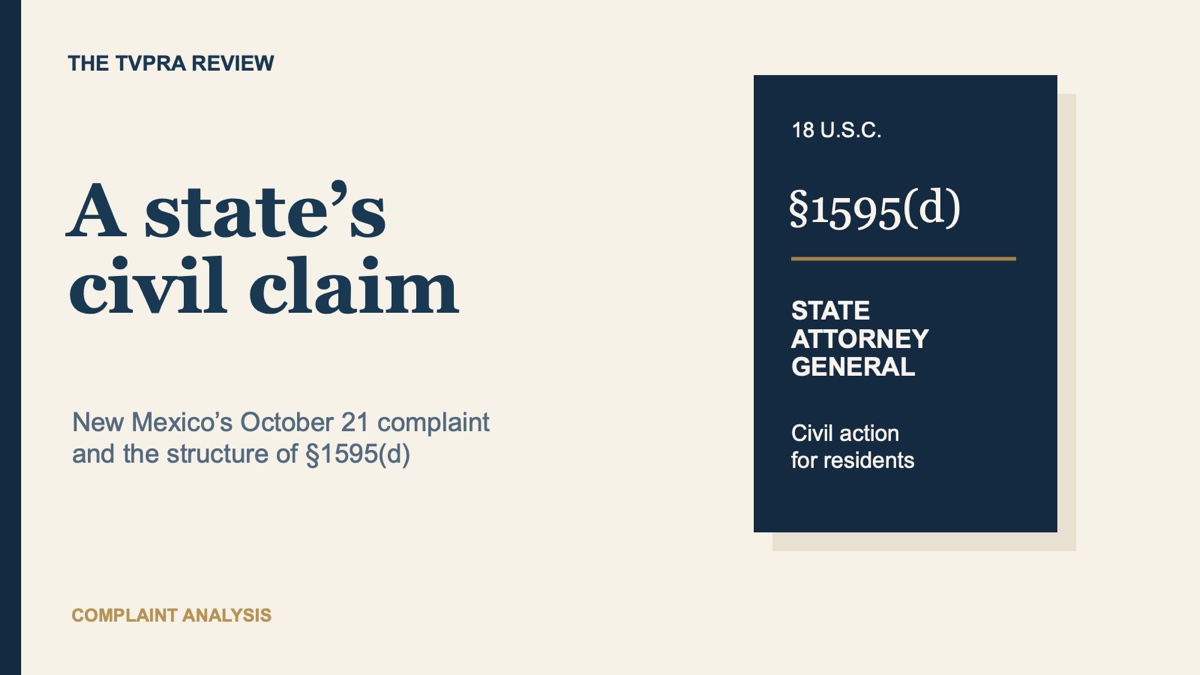
New Mexico’s civil lawsuit against Jeffrey Epstein’s longtime lawyer and accountant presents a question that extends beyond the notoriety of the underlying events: how can a state seek relief for residents under the federal trafficking statute, and what must it allege against the people whose services allegedly supported the trafficking?
The October 21 complaint, filed in the District of New Mexico as No. 1:26-cv-03543, names Darren K. Indyke, Richard D. Kahn, Epstein’s estate and the 1953 Trust. Count One invokes 18 U.S.C. §§1591(a)(1)–(2) and 1595(d). It alleges that Indyke and Kahn knowingly facilitated and benefited from a trafficking venture, including through financial arrangements connected to abuse at Zorro Ranch. These are the state’s allegations, not findings of liability.
The men publicly deny wrongdoing. In October 21 reporting by the Associated Press, lawyer Dan Weiner said they “emphatically reject” the allegations. NPR reported October 22 that their lawyers denied knowingly facilitating Epstein’s sexual abuse or trafficking. Those are public responses; they are not being described here as filed answers.
The state is using an existing, distinct civil route
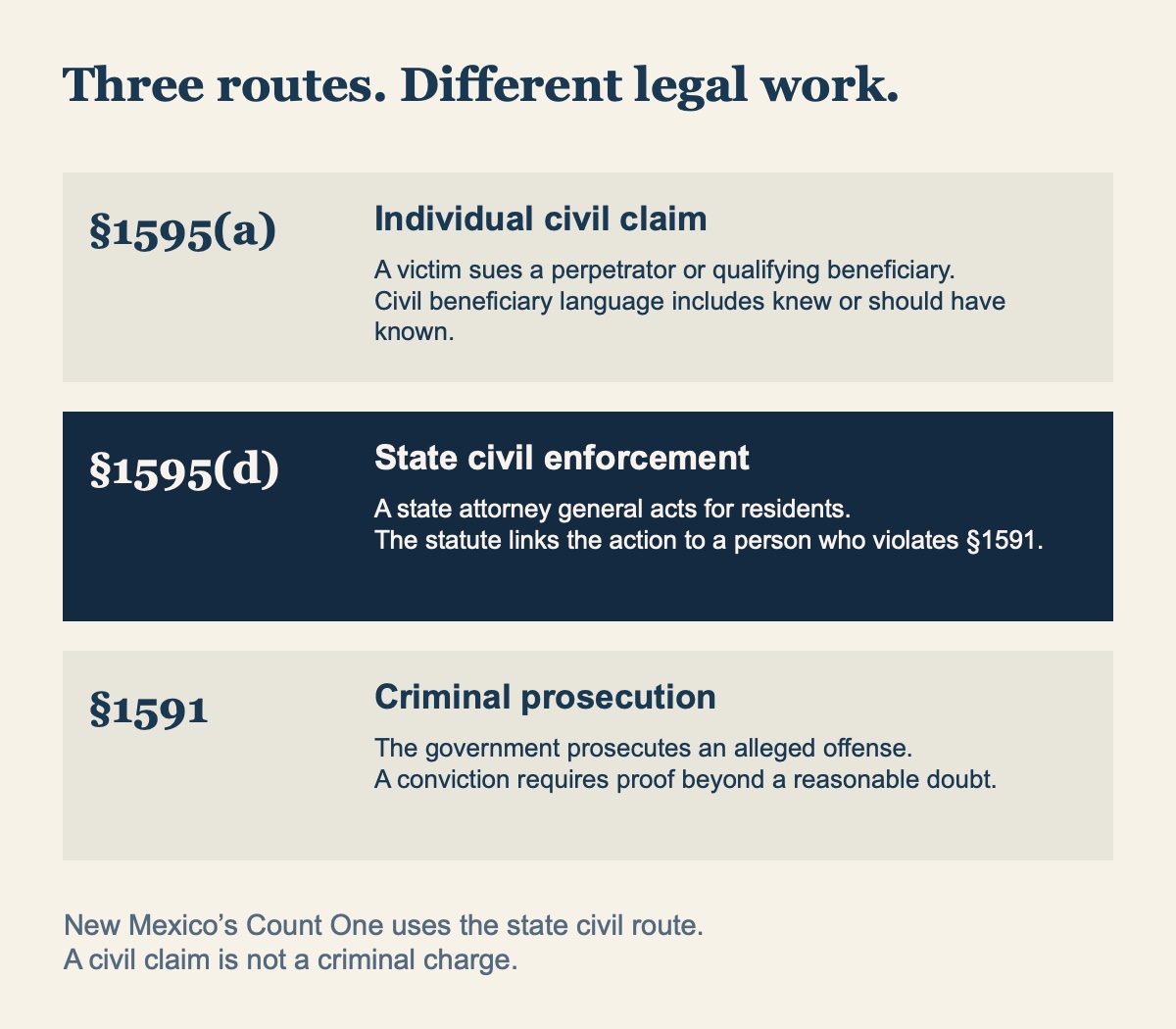
Section 1595(d) authorizes a state attorney general to bring a civil action as parens patriae on behalf of state residents. The provision applies when the attorney general has reason to believe that residents’ interests have been, or are threatened or adversely affected, by a person who violates §1591. It permits suit in an appropriate federal district court to obtain appropriate relief.
Parens patriae describes the state acting on behalf of its residents’ interests. Here, that role is backed by an express federal authorization. It is not a new power created in 2026: Congress added subsection (d) in April 2018. The recent development is New Mexico’s use of it in this complaint.
The wording identifies several questions that deserve separate attention: the affected interests of residents, the connection to a person who violates §1591, the proper court and the relief appropriate to the claim. The attorney general’s reason to believe supplies a statutory basis to bring the action. It does not turn the complaint’s account into proof of every underlying violation or entitlement to every requested remedy.
Count One alleges harm to New Mexico and its residents from the alleged facilitation of abuse and commercial sex acts in the state. Zorro Ranch provides a concrete geographic connection within the state’s theory. The pleading’s allegations about financial activity then attempt to connect each individual defendant to the alleged trafficking. Both connections matter; a description of Epstein’s conduct alone would not explain why these defendants are liable under the asserted statutory route. Complaint, paragraphs 159–173, pages 36–39.
Why §1595(a) cannot simply be substituted
Much civil trafficking litigation involves a private action under §1595(a). That subsection authorizes an individual victim of a Chapter 77 violation to sue the perpetrator or a qualifying beneficiary. Its beneficiary language reaches knowing benefits, attempted benefits and conspiracies to benefit from participation in a venture the person knew or should have known had engaged in a covered violation. Damages and reasonable attorneys’ fees are expressly specified there.
Subsection (d) is written differently. It authorizes the state’s action against a person who violates §1591, the federal sex-trafficking provision. Its text does not reproduce subsection (a)’s constructive-knowledge formulation or its broader reference to violations across Chapter 77. Reading the state’s count as an ordinary private beneficiary claim would therefore skip the statutory link on which the state relies.
The distinction affects how the allegations should be evaluated. “Should have known” under the private civil language is not interchangeable with the knowledge and reckless-disregard language relevant to the §1591 theory pleaded here. That does not resolve whether the state can prove its case. It identifies which questions its federal count presents.
It also cautions against importing results from private hotel or supply-chain cases without examining their statutory basis and procedural stage. A decision addressing §1595(a) may illuminate an issue, but it does not automatically supply the complete test for §1595(d). The Review’s civil-remedy explainer describes the private route; this complaint requires an additional statutory comparison.
The alleged conduct must connect the professionals to the venture
Section 1591(a)(1) addresses specified conduct such as recruiting, transporting, providing, obtaining or maintaining a person, with the required commerce connection and mental state concerning commercial sexual exploitation. Paragraph (a)(2) addresses financial or other benefits from participation in a venture engaged in conduct violating paragraph (a)(1). The statute defines participation for §1591 as knowingly assisting, supporting or facilitating a violation of subsection (a)(1).
The accompanying mental-state language addresses knowledge or, subject to the advertising exception, reckless disregard concerning the use of force, fraud or coercion, or the person’s minority and being caused to engage in a commercial sex act. The precise application depends on the theory asserted. The statute does not make someone a participant merely because a professional relationship existed.
New Mexico’s pleading attempts to supply that missing connection through alleged acts, financial benefits and knowledge. As to Indyke, it alleges management of cash and accounts connected to payments for commercial sex acts, including withdrawals allegedly structured to avoid reporting. As to Kahn, it alleges oversight of accounts and transactions used for travel and other expenses connected to trafficking. The state links their compensation to their alleged knowing assistance rather than relying solely on their titles. Complaint, paragraphs 148–170, pages 33–38.
Those allegations require defendant-specific scrutiny. A payment record could help establish that money moved without, by itself, establishing the purpose a defendant understood or the assistance the defendant knowingly provided. Professional training may be part of the state’s proposed inference; it does not replace proof of the governing elements. The pleading’s account of repeated transactions and concealment is designed to support an inference of knowing involvement, and the public denial contests that account at its core.
That makes the claim more specific than an argument that every adviser to a wrongdoer shares liability. The relevant inquiry concerns what each person allegedly did, how that conduct connected to a statutory violation, what the person knew or recklessly disregarded under the asserted theory, and what benefit was received. The Review’s participation guide explains why a business or professional label cannot answer those questions on its own.
Assets, defendants and remedies have different roles
The estate and trust should not be treated as interchangeable with the individual defendants. Paragraph 20 expressly says the 1953 Trust is named as a holder of assets through which relief may be satisfied, not as an alleged perpetrator of trafficking or racketeering. That distinction limits what can fairly be inferred from its presence in the caption. Complaint, paragraph 20, page 6.
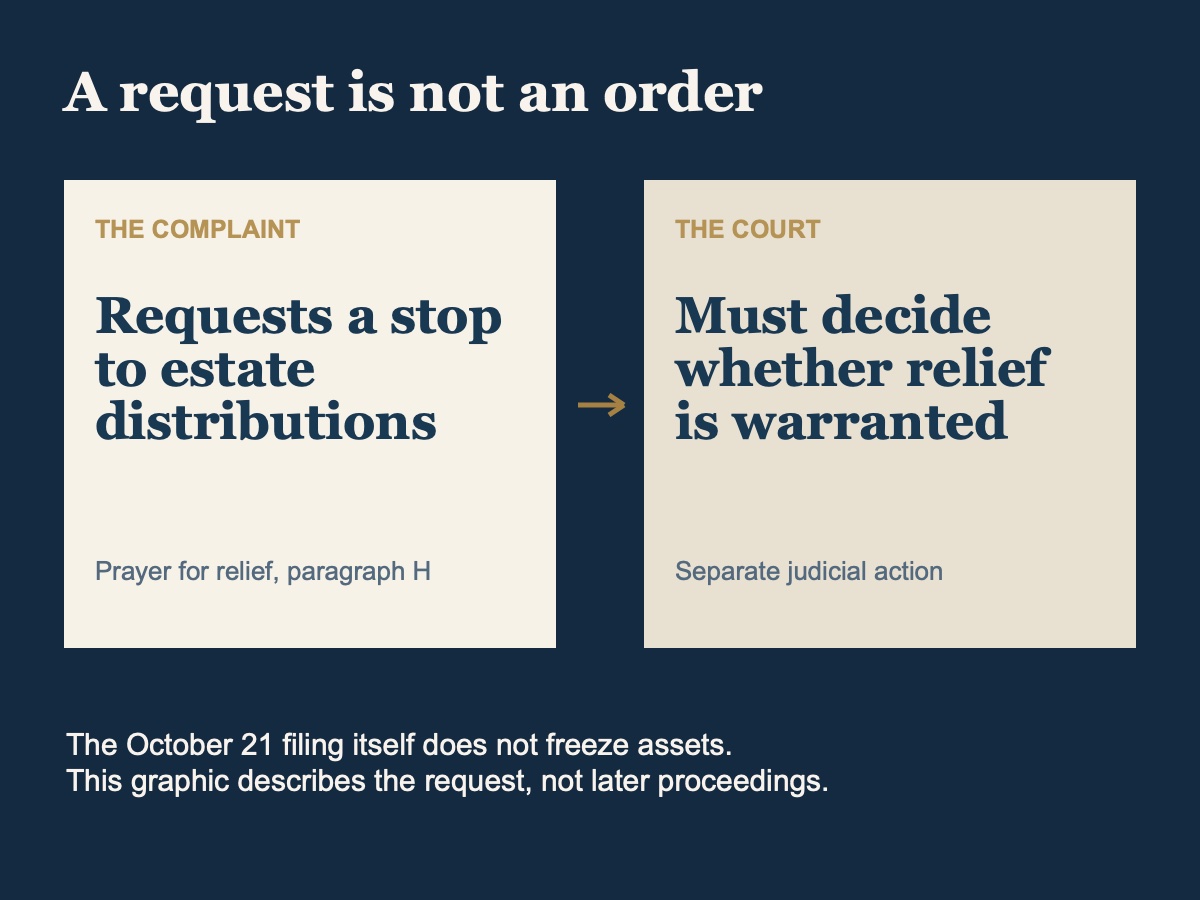
The prayer for relief likewise distinguishes requested remedies and legal grounds. Paragraph H asks for an order preventing the estate’s co-executors from making distributions during the litigation, citing both New Mexico racketeering law and §1595(d). Paragraph G requests relief under §1595, including damages and other forms of recovery. Other requests rely on state law for divestiture, restrictions and treble damages. Complaint, page 48.
A request to preserve assets is different from a determination that those assets belong to the state or survivors. It is also different from an entered restraint order. The complaint asks the court to act; the prayer itself does not freeze distributions. And §1595(d)’s authorization of appropriate relief does not mean every remedy listed in a pleading follows automatically from that subsection.
The legal bases matter for any eventual account of the result. A court could address a state-law request, a federal trafficking claim or a procedural question without deciding all the others. Reporting should identify the actual basis and scope of the ruling rather than attributing the entire requested package to one statutory provision.
Civil enforcement and criminal accountability remain separate
New Mexico’s suit uses an alleged violation of a criminal statute as the predicate for a civil action. That structure does not make the filing a criminal charge against Indyke or Kahn. Nor would a civil ruling, by itself, amount to a criminal conviction or a prison sentence.
The state-enforcement route also differs from a survivor bringing an individual damages claim. The identity of the plaintiff, the statutory authorization, the elements and the remedies need to be tracked separately. Calling all three proceedings “trafficking cases” can obscure those differences just when they matter most.
The complaint’s broader significance lies in its effort to connect a state’s residents, alleged professional assistance and control over assets within an existing civil enforcement provision. Whether that effort succeeds requires legal decisions and evidence beyond the state’s accusation. The useful questions are how the state establishes the §1591 link, how it proves each defendant’s conduct and knowledge, and which requested remedies the court finds legally available.
This analysis examines the October 21 complaint and governing statutory text. Public RECAP docket entries reviewed extend through October 26; subsequent procedural developments were not independently verified.
Read the complaint, §1595, §1591 and the public docket archive. For interpreting a later order, see What did the court actually decide?.
This is analysis of allegations in a civil complaint, not a merits ruling. Public RECAP entries reviewed extend through October 26; subsequent proceedings were not independently verified.
Read the source
- Complaint date