
Case analysis
A banking decision reshapes a Manhattan hotel-trafficking lawsuit
An October ruling applies the Second Circuit’s venture-participation test to hotels, showing why alleged knowledge and room revenue may leave a civil claim incomplete.
Source reviewed

A federal judge in Manhattan dismissed a woman’s civil trafficking claims against four hotel defendants on October 2, applying a recent banking decision to a question that reaches well beyond either industry: when does selling a service become participation in the customer’s venture?
In Doe (O.B.J.) v. Inter-Continental Hotels Group, No. 1:25-cv-10815, Judge Lewis A. Kaplan concluded that the complaint did not plausibly allege the necessary participation. His opinion dismissed the claims against the four moving defendants with prejudice.
The reasoning matters because the court assumed, for purposes of its analysis, that the plaintiff had adequately alleged trafficking, the defendants’ financial benefit, and their actual or constructive knowledge of the trafficking. The complaint still failed on a separate element: what the defendants allegedly did to take part in a venture.
What the October opinion decided
The plaintiff alleged that she was trafficked at two Manhattan hotels in 2015 and 2016. She sued their alleged operators and franchisors under the federal civil trafficking remedy, 18 U.S.C. § 1595.
The moving defendants were CWI Chelsea Hotel, LLC; Brisam Management (DE) LLC; Six Continents Hotels, Inc.; and Holiday Hospitality Franchising, LLC. The opinion identifies two other named franchisors that had not appeared. Its dismissal expressly addresses the four moving defendants.
This was a motion-to-dismiss decision. The court was evaluating whether the pleaded facts, with the appropriate favorable inferences, stated a legally sufficient claim. It did not conduct a trial or find that the alleged trafficking never happened.
The complaint described recurring room rentals, alleged warning signs, failures to train or intervene, and policies that allegedly made the properties favorable places for traffickers to operate. Kaplan treated the underlying allegations as describing ordinary services and failures to act, rather than facts establishing a shared undertaking with the trafficker. Opinion, pages 13–20.
How a banking case supplied the rule
The controlling appellate decision was Mueller v. Deutsche Bank AG, No. 25-1162, decided August 3, 2026. The estates and family members of three Americans kidnapped and killed by ISIS alleged that Deutsche Bank’s financial services supported fundraising connected to the organization and its affiliates.
The Second Circuit affirmed dismissal because the complaint did not plausibly allege participation in a qualifying venture. Its decision left the knowledge question, and certain other disputed elements, unresolved.
The court looked for facts showing that the defendant took part in an enterprise involving risk, potential gain, or both. Relevant considerations included a financial interest in the venture, common purpose, operational control, a continuing relationship, and conduct extending beyond an arm’s-length transaction. It described a fact-sensitive inquiry, not a rule that every factor must be present.
In Mueller, allegations of routine financial services, fees and transaction processing did not establish that connection. The court distinguished the tailored, ongoing business support alleged in the Seventh Circuit’s Salesforce case. A service’s importance to the customer did not, by itself, establish participation in the customer’s venture.
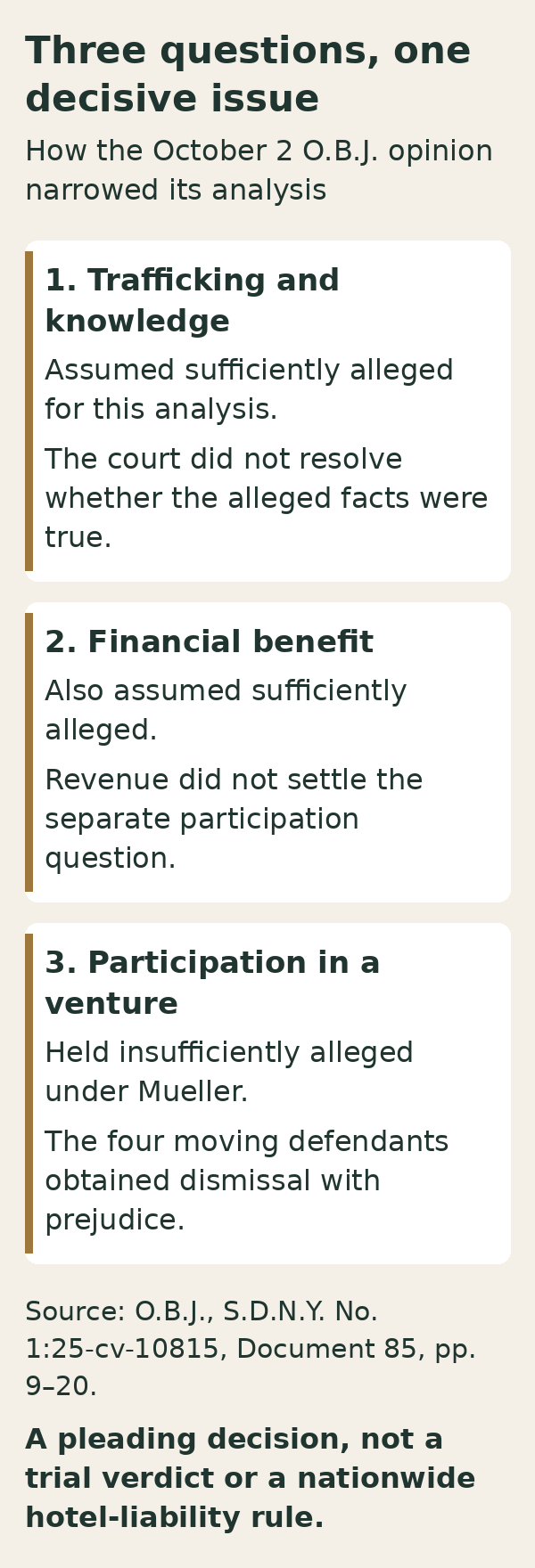
The court’s assumptions narrowed the issue it decided. They were not findings that the alleged facts were proven.
Why the hotel’s proximity did not change the result
The plaintiff argued that a hotel providing the location of trafficking was more directly connected to the abuse than a bank supplying financial services several steps away. Kaplan concluded that this distinction did not overcome Mueller: the alleged services still needed to connect the defendant to a shared enterprise, beyond a series of ordinary transactions.
The opinion also addressed allegations that management or staff solicited commercial sexual services from the plaintiff and others. Kaplan found those allegations too cursory, including insufficient detail to support an inference that employees were acting within the scope of their employment. That was a ruling on the pleading, not a finding that the alleged conduct did or did not occur.
The court identified examples from other decisions that could support participation: acting as a lookout for police, allocating space for a trafficker, forming a partnership, or providing tailored services or special benefits. Those examples illustrate the inquiry. They are neither a universal checklist nor a guarantee that any particular allegation will establish liability. Opinion, pages 19–20 and footnote 82.
What readers should take from the decision
For readers following civil accountability, the October opinion shows the importance of keeping the statutory elements separate. Alleged warning signs may bear on knowledge. Revenue may bear on benefit. Participation asks another question about the relationship and conduct connecting the defendant to the venture.
This is a Southern District of New York opinion applying Second Circuit precedent. It should not be read as a new nationwide hotel-liability rule. Nor should its pleading analysis be treated as interchangeable with a decision about whether evidence is sufficient for trial.
The distinction is useful when reading the Review’s coverage of venture participation, the Northbrook summary-judgment decision, and the business support alleged in Salesforce. Each asks what connects a particular defendant to alleged trafficking, but the court, facts and procedural stage shape the answer.
This analysis addresses the October 2 opinion and its reasoning; it does not report subsequent proceedings.
Read the source
- Opinion date