
Case analysis
Ninth Circuit leaves Meta’s §1595 dismissal intact, revives narrow reporting-design theory
An unpublished November 3 decision distinguishes Instagram’s user-reporting infrastructure from protected publishing decisions without reviving the federal trafficking claim.
Source reviewed
A limited reversal, not a revived federal trafficking claim
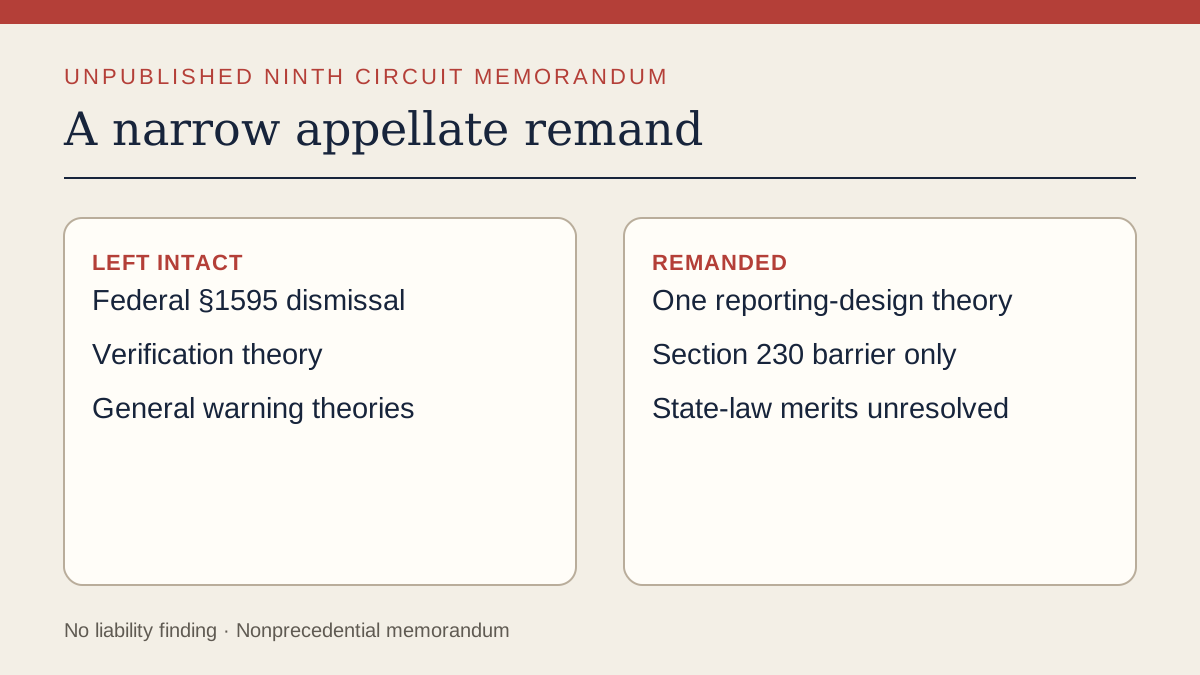
The Ninth Circuit has left intact the dismissal of a trafficking survivor’s federal civil claim against Meta while reopening one narrow California product-design theory: whether Instagram provided an adequate mechanism for users to report sex trafficking.
In Doe (K.B.) v. Facebook, Inc., No. 25-2246, the panel held that Section 230 bars the plaintiff’s claim under 18 U.S.C. §1595, her identity- and age-verification design theory, and her failure-to-warn claims. But the panel concluded that circuit precedent forecloses Meta’s Section 230 defense to the reporting-mechanism design theory. The case returns to the district court for further proceedings on the theory that clears that particular barrier. Memorandum, pp. 2–6.
That distinction matters. The court did not find that Meta violated California law, that Instagram is a product for purposes of the asserted claims, or that a reporting defect caused the plaintiff’s injuries. It expressly left the surviving theory’s cognizability to the district court. The six-page disposition is unpublished and states that it is not precedent except as provided by Ninth Circuit Rule 36-3. Its importance is as an application of existing circuit decisions, particularly Doe 1 v. Twitter, rather than a new precedential rule governing platform liability. Memorandum, p. 1 n.*, p. 6 n.6.
How the case reached the panel
The district-court history requires separating two orders. In March 2024, Judge Rita F. Lin granted judgment on the pleadings on the federal trafficking theory but allowed amendment. That decision, reported at 724 F. Supp. 3d 882, rejected efforts to distinguish Meta’s connection algorithms from the third-party content those algorithms facilitated. It was not the final dismissal reviewed on appeal. March 20, 2024 order.
The plaintiff then pleaded California design-defect and failure-to-warn theories alongside her §1595 claim. On March 3, 2025, Judge Lin dismissed the third amended complaint without leave to amend, concluding that Section 230 barred all the claims as pleaded. That later decision is reported at 768 F. Supp. 3d 1057. Because the court resolved the case on Section 230 grounds, it did not reach Meta’s other dismissal arguments. March 3, 2025 order, pp. 7–13.
Five months later, the Ninth Circuit decided Doe 1 v. Twitter, Inc., 148 F.4th 635. That published August 2025 opinion supplied the reporting-infrastructure distinction decisive in K.B.’s appeal. The panel, consisting of Judges Kenneth K. Lee, Salvador Mendoza Jr., and Ana de Alba, heard argument on August 12, 2026, and issued its mixed disposition on November 3. Twitter opinion; K.B. memorandum, pp. 1, 4–5.
Why the §1595 theory remained barred
The panel evaluated the claims through the familiar Section 230 inquiry: whether the defendant provides an interactive computer service, whether the theory treats it as a publisher or speaker, and whether the information comes from another content provider. The dispute concerned the latter two elements. The analysis therefore turned on what conduct the plaintiff sought to make actionable, not simply the cause of action’s label. Memorandum, p. 2, applying Barnes v. Yahoo! and Doe v. Grindr.
The plaintiff advanced two §1595 theories. First, she alleged that Meta failed to exclude traffickers or take reasonable steps to prevent trafficking, allowing Instagram to become a breeding ground for it. The panel treated that theory as an attempt to impose liability for reviewing and policing user-created material, an activity protected under the circuit’s Section 230 cases.
Second, she alleged that Instagram’s algorithms generated targeted recommendations and encouraged connections between traffickers and vulnerable users. The panel held that reframing the claim around connections did not avoid the immunity applicable to the user-generated content those connections facilitated. It relied on Dyroff v. Ultimate Software Group and the district court’s earlier reasoning. Memorandum, p. 3.
This is a ruling about these pleaded platform theories and the applicable Section 230 framework. It is not a holding that §1595 categorically excludes technology companies, nor does it replace that statute’s substantive beneficiary-liability requirements with a universal platform-specific rule.
The separate FOSTA issue also needs care. In its final order, the district court recorded the plaintiff’s concession that the trafficking exception did not apply under then-current Ninth Circuit precedent, despite her argument that Does 1–6 v. Reddit was wrongly decided. The November memorandum does not announce a new interpretation of that exception. Its principal §1595 discussion concerns the protected publishing functions implicated by the two theories before it. District order, p. 7 n.2; memorandum, pp. 2–3.
The distinction is consequential because ordinary §1595 beneficiary liability and the FOSTA exception are not interchangeable inquiries. Section 1595 includes a knew-or-should-have-known standard concerning the venture’s prohibited conduct. But, under Reddit as applied in Twitter, a plaintiff invoking the exception to otherwise applicable Section 230 protection must plausibly allege that the platform’s own conduct violated §1591. Twitter held that the allegations of reported abuse material, nonremoval, and sitewide advertising revenue before it did not satisfy that requirement. That analysis supplies context for the district court’s concession discussion, not an additional holding newly announced in K.B.’s memorandum. Memorandum, p. 2 n.1; Twitter, slip op. pp. 13–15.
The panel also rejected the argument that Moody v. NetChoice had overruled Dyroff. That brief conclusion preserves existing circuit law for this appeal. It should not be presented as resolving every dispute over recommendation algorithms or the relationship between First Amendment editorial discretion and Section 230. Memorandum, p. 3 n.2.
Account verification remains on the publishing side
The plaintiff’s first design theory focused on identity and age verification during account creation. She argued that requirements imposed before a user posts content are distinct from publishing decisions.
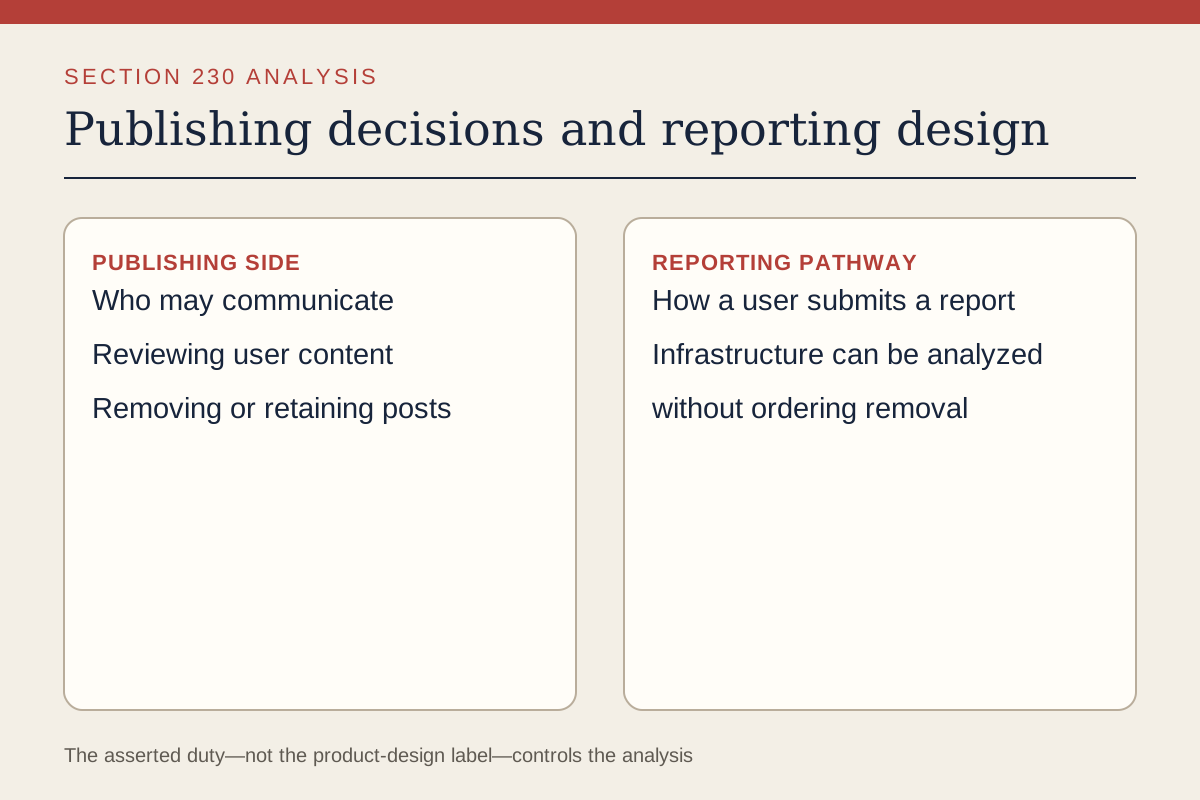
The panel disagreed. Following Doe v. Grindr Inc., 128 F.4th 1148, it treated the verification requirements alleged here as connected to determining who may use the platform to communicate. Moving the proposed safeguard to the account-creation stage did not make the asserted duty independent of Meta’s publishing role. Memorandum, p. 4; Grindr, 128 F.4th at 1152–53.
That reasoning distinguishes Lemmon v. Snap, which allowed a design claim concerning a speed filter alleged to encourage dangerous driving. As the panel explained, the dangerous-driving duty in Lemmon was independent of monitoring or publishing third-party messages. The identity-verification theory in K.B.’s complaint was not. The relevant distinction is the duty asserted and its relationship to publication, rather than the general availability of a safer design. Memorandum, p. 4 n.3.
Reporting infrastructure is the narrow exception
The surviving theory concerns the tools through which users can report trafficking. The complaint alleged an inadequate reporting mechanism and the absence of an immediate-response tool through which Meta would act promptly. These remain allegations, not findings about Instagram’s systems or Meta’s conduct.
The district court had understood the theory as necessarily demanding that Meta monitor reports and moderate third-party content. The appellate panel instead applied Twitter: improving a reporting mechanism would not necessarily require monitoring third-party content. On that reasoning, Section 230 does not itself foreclose the reporting-design theory. District order, pp. 10–11; memorandum, pp. 4–5.
Twitter explains why that distinction is more than a change in terminology. Its plaintiffs challenged features of the reporting process itself, including barriers to reporting child sexual abuse material, limitations on reporting private messages, and account-related reporting requirements. The court reasoned that an interface could be improved without requiring the platform to review or remove particular third-party content. Although better reporting could ultimately produce more content removals, that consequence did not necessarily transform the asserted design duty into a publishing obligation. Twitter, 148 F.4th at 644–45.
By contrast, Twitter rejected a theory demanding removal of reported material pending review. That proposed obligation directly regulated whether third-party content remained published. It also rejected the challenged search and amplification theories. Read together, the decisions preserve a distinction between the reporting pathway and the publication decisions that may follow a report. Twitter, 148 F.4th at 645–46.
K.B.’s memorandum applies that distinction without developing a detailed account of how any particular Instagram redesign would work. It therefore should not be read as approving every claim involving a report, a response deadline, or harmful material left online. The surviving theory must still be understood within the reporting-infrastructure rationale on which the panel relied.
Another distinction is equally important: user reporting is not the same theory as a platform’s statutory reporting obligation under 18 U.S.C. §2258A. Twitter separately addressed a negligence-per-se theory based on that statute. K.B.’s panel expressly rejected Meta’s attempt to tie Twitter’s reporting-design analysis to its separate §2258A discussion. The November decision does not revive a §2258A-based claim in this case. Memorandum, p. 5 n.4; Twitter, 148 F.4th at 645, 647.
Nor did the published 2026 decision in Doe 1 v. Meta Platforms, 174 F.4th 1159, dispose of this issue against K.B. As the panel noted, the reporting-infrastructure argument in that separate litigation had been forfeited. A forfeiture ruling does not supply a merits rejection of a theory properly presented in another case. Memorandum, p. 5 n.4; Doe 1 v. Meta, 174 F.4th at 1167 n.4.
General warnings remain barred
The panel also affirmed dismissal of claims that Instagram should have warned users about trafficking, interactions with traffickers, and the dangers of fake accounts. It again applied Grindr, which distinguished generalized risks associated with third-party communications from a defendant’s independent knowledge of a specific criminal conspiracy. Memorandum, pp. 5–6.
The comparison was Doe v. Internet Brands, where a warning theory concerned a known conspiracy and information acquired outside the website’s publishing activities. The K.B. panel found no comparable allegation of independent knowledge here. Its analysis does not eliminate every possible duty to warn, but it rejects these warnings as a route around Section 230 for the generalized harms alleged. Memorandum, pp. 5–6 n.5; Grindr, 128 F.4th at 1154.
What remains for the district court
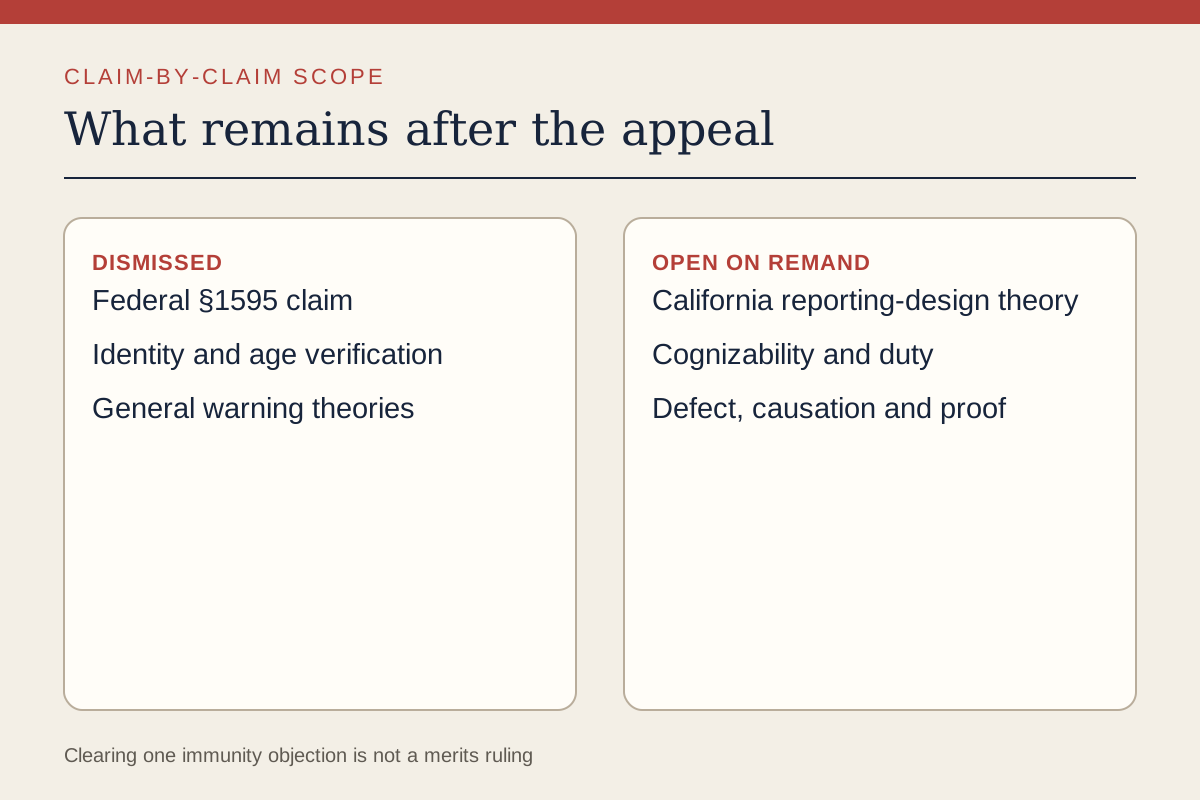
The immediate practical consequence is a narrower case, not a finding of liability. The §1595 claim stays dismissed. So do the verification and warning theories. The reporting-design theory survives the Section 230 objection addressed on appeal, while Meta’s alternative challenges remain available for consideration in the district court. Memorandum, p. 6 n.6.
For litigants, the decision illustrates the need to identify the precise obligation a design claim would impose. A general assertion that a platform should have prevented trafficking can implicate publishing decisions. A challenge to the usability or structure of a reporting pathway can raise a different Section 230 question. Calling either theory product design does not decide which category it occupies.
The same precision matters when evaluating evidence and remedies. A proposed reporting-interface change should be distinguished from a demand that particular posts be removed or particular accounts excluded. The latter demands resemble the publishing obligations that Twitter, Grindr, and this memorandum protect. The panel did not prescribe a compliant interface, establish a response timetable, or hold that any proposed reporting tool would have prevented this plaintiff’s injuries. Those are not details that can be filled in by describing the result simply as a trafficking suit against Meta being revived.
The next questions are substantive ones the panel did not answer: whether California law recognizes the asserted claim, what duty and defect could be established, and whether the plaintiff can prove the necessary connection between the alleged reporting failure and her injuries. Clearing Section 230 is only one step. The November memorandum keeps that step distinct from the state-law merits and leaves the federal trafficking dismissal undisturbed.
The six-page memorandum is unpublished and nonprecedential except as Ninth Circuit Rule 36-3 provides. It leaves the federal §1595 dismissal intact and does not decide liability on the remanded California theory.
Read the source
- Decision date