
Case analysis
Milwaukee Tool appeal tests where forced-labor accountability begins
The Seventh Circuit’s November 4 argument presents two routes to a civil remedy: Congress’s grant of overseas reach and the prohibition on benefiting from forced labor at home.
Source reviewed
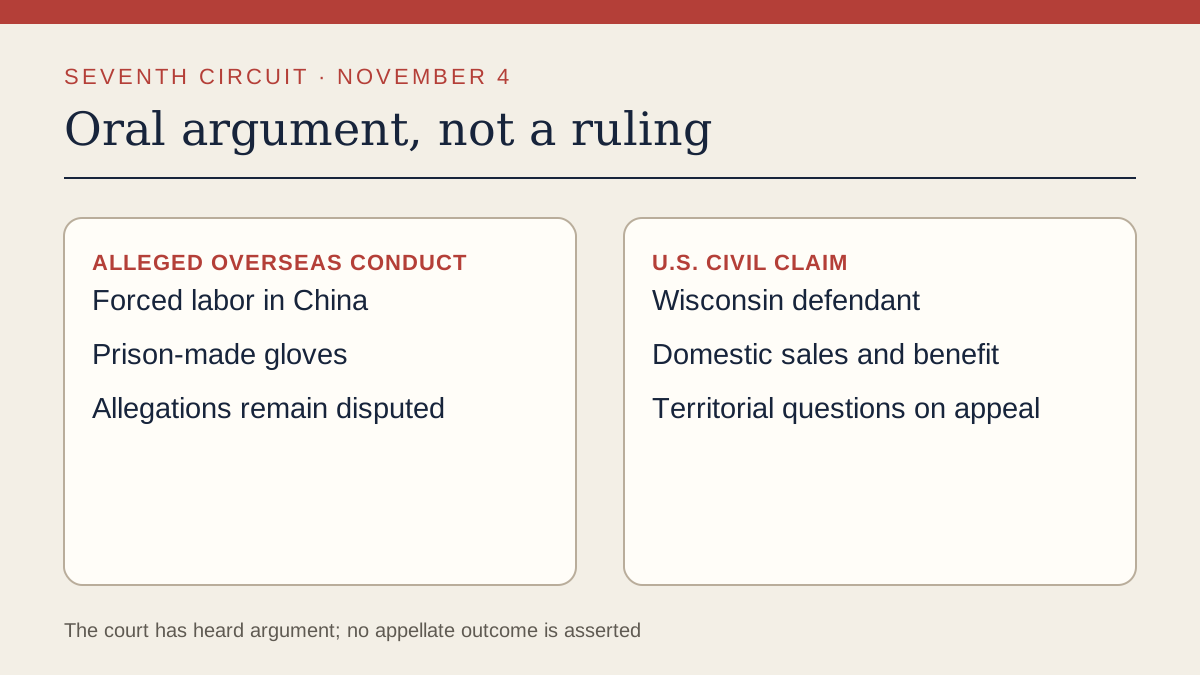
The Seventh Circuit heard argument on November 4 in Xu Lun's suit over allegedly prison-made gloves. The appeal presents two different routes to a civil remedy: Congress's grant of overseas reach and the prohibition on benefiting from forced labor at home.
Publication date: November 5, 2026. Event date: November 4, 2026. Status checked: November 5, 2026.
The Seventh Circuit has heard a consequential supply-chain appeal, but it has not decided the questions this article examines. In Xu Lun v. Milwaukee Electric Tool Corporation, No. 25-3347, the court's official recording index confirms oral argument on November 4, 2026. The dispute is whether a person alleging forced labor in China can pursue a federal civil claim against a Wisconsin company for its alleged role in benefiting from that labor. The answer could affect which conduct courts examine before survivors can seek evidence about an international supply chain. Official argument index; argument recording.
It is tempting to describe the case simply as a dispute about whether an American law applies abroad. That leaves out an important alternative. Xu argues both that Congress authorized the relevant overseas application and that the company's alleged domestic benefiting is itself conduct the law regulates. Those are separate questions. An appellate court could reject the first and still have to answer the second. Xu's opening brief.
The allegations and the ruling under review
Xu, a Taiwanese activist using a pseudonym, alleges that he was forced to manufacture Milwaukee-branded gloves while imprisoned in China's Chishan Prison. He describes coercion, long hours and little or no compensation, and alleges that the gloves reached American consumers through a related corporate supply chain. These remain allegations, not findings against Milwaukee Tool. In a statement reported by NPR in July 2024, the company denied the allegations and said its investigations had found no evidence of forced labor in its gloves. District court order, December 1, 2025; NPR report, published July 18 and updated August 8, 2024.
Judge Brett H. Ludwig dismissed the claim against Milwaukee Tool with prejudice on December 1, 2025, reasoning that it sought an impermissible overseas application of the federal civil remedy. He treated the location of the alleged forced labor as decisive and rejected the argument that domestic benefiting supplied a domestic application. The separate dismissal of parent company Techtronic Industries was without prejudice for lack of personal jurisdiction. The appeal against that company was later voluntarily dismissed. District order; appellate docket.
A legal dismissal is different from a determination, after evidence, that the supply-chain allegations are false. Conversely, reversing a legal dismissal would not establish that they are true. This appeal concerns access to the civil remedy, not a damages award or a finding that Milwaukee Tool used forced labor.
Three provisions that do different work
The legal dispute becomes clearer when the relevant provisions are separated.
Section 1589 addresses forced labor and benefiting from it. Subsection (a) prohibits obtaining or providing labor through specified coercive means. Subsection (b) separately addresses a person who knowingly benefits from participation in a venture engaged in forced labor, with knowledge or reckless disregard of the coercive means. That second provision matters because an alleged beneficiary need not be the person physically controlling the worker. It does not, however, dispense with participation or the required state of mind. 18 U.S.C. § 1589.
Section 1595 supplies the private civil remedy. It allows a victim of a Chapter 77 violation to seek damages and reasonable attorney fees against a perpetrator or a qualifying beneficiary. Its beneficiary language includes participation in a venture that the defendant knew or should have known had engaged in a violation. That civil standard should not be casually substituted for § 1589(b)'s separate wording. Which theory is pleaded, against whom, and on what facts remains important. 18 U.S.C. § 1595.
Section 1596 addresses overseas reach. It expressly grants extraterritorial jurisdiction over enumerated trafficking offenses, including § 1589, when specified connections to the United States exist, including an alleged offender's presence here. Its list does not separately name § 1595. The disagreement is what that omission means when the civil remedy incorporates an offense that Congress expressly made applicable abroad. 18 U.S.C. § 1596.
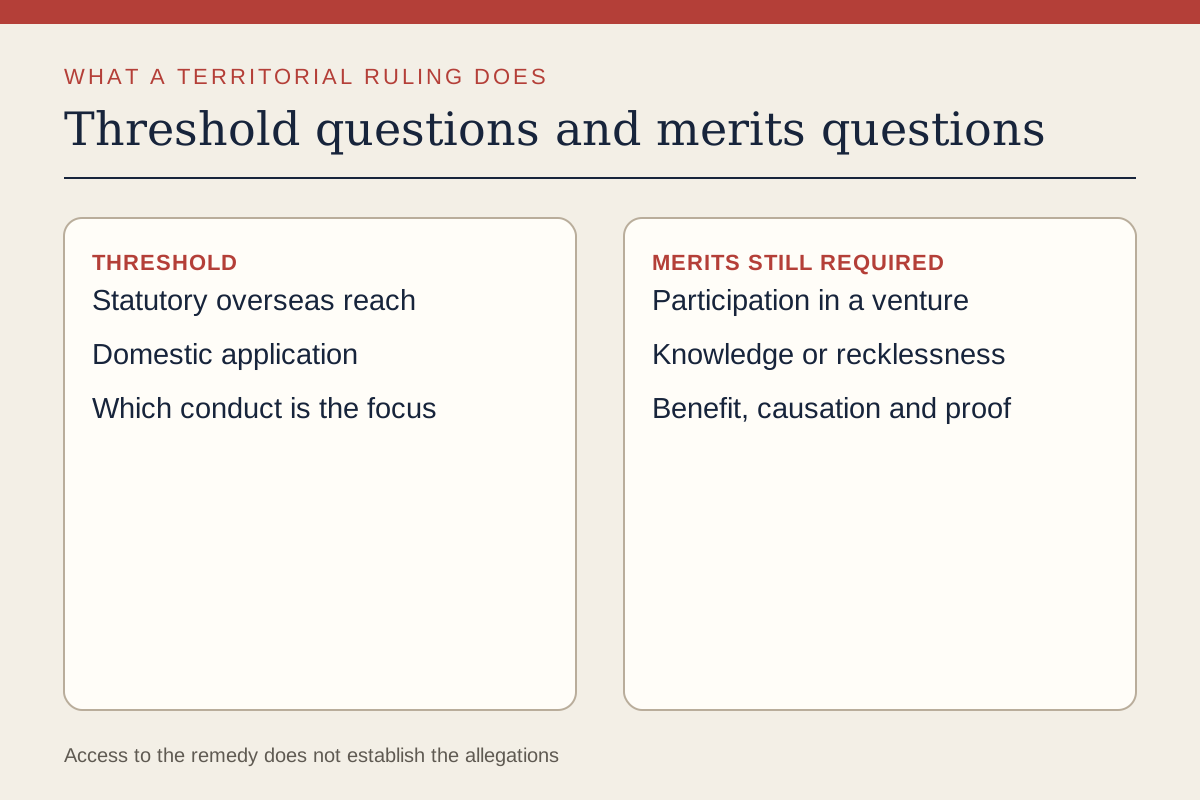
These are connected provisions, not interchangeable ones. A court can have authority over a defendant yet conclude that a particular statutory cause of action does not reach the alleged conduct. It can also recognize overseas statutory reach without finding that the plaintiff has adequately alleged participation, knowledge or causation. Calling every question here simply “jurisdiction” obscures those distinctions.
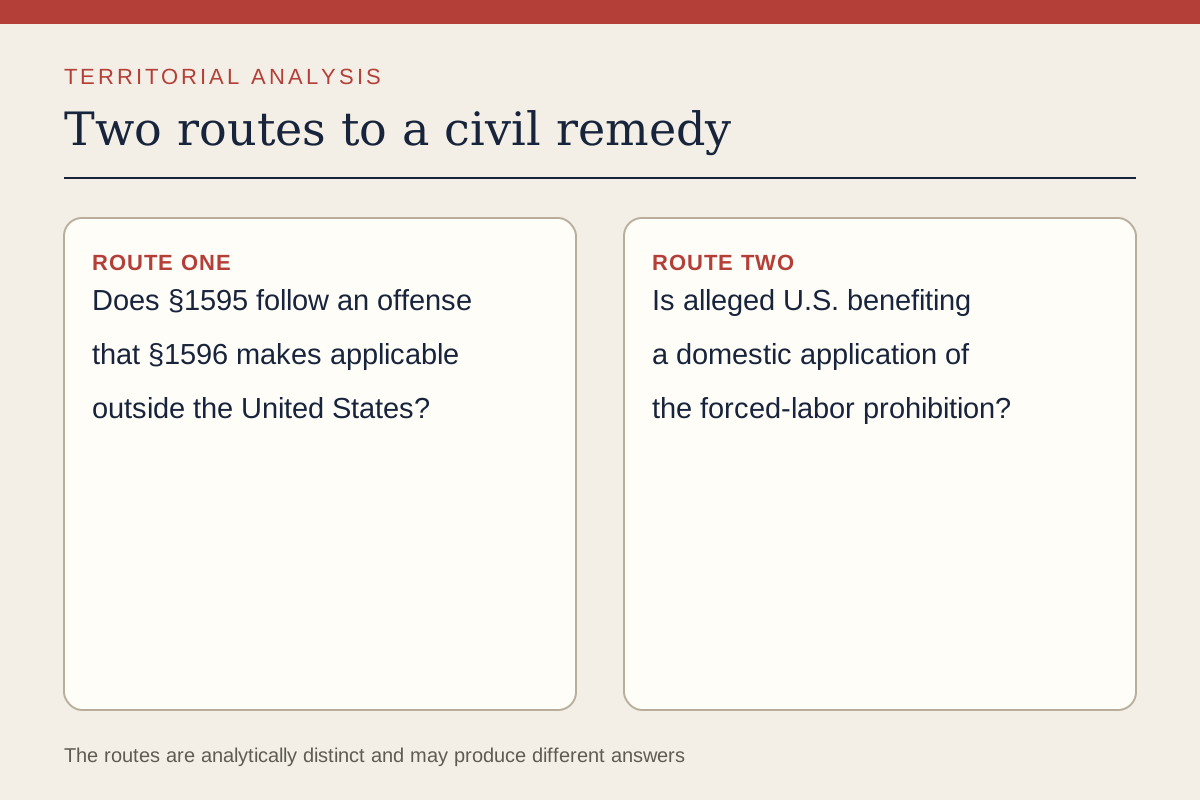
The first route: does the civil remedy follow the overseas offense?
The Supreme Court's decision in RJR Nabisco v. European Community, 579 U.S. 325 (2016), provides the framework. Courts first ask whether Congress clearly indicated that a provision reaches abroad. If not, they ask whether the claim nevertheless involves a domestic application, based on the provision's focus and the location of the relevant conduct. The Court also examined RICO's private remedy separately from its substantive prohibitions and required a domestic injury for that civil claim. It did not announce that every federal civil remedy necessarily stops at the border. RJR Nabisco.
That creates a real interpretive problem for trafficking litigation. One reading emphasizes the distinction between enforcing a criminal prohibition and authorizing a private damages suit. On that view, expressly extending an offense is not enough to extend a different civil provision. The competing reading emphasizes § 1595's direct reference to Chapter 77 violations: if the incorporated violation validly reaches the conduct, the remedy follows it. Xu advances that latter position. Opening brief.
There is significant appellate authority for that approach, but its facts and statutory setting must be kept straight. In Roe v. Howard, 917 F.3d 229 (4th Cir. 2019), the Fourth Circuit held that § 1595 could support recovery for overseas conduct within the reach of the relevant predicates. It distinguished RICO's civil text and relied on incorporation, structure and context. The underlying abuse occurred in 2007, and the court identified then-existing grounds for the predicates' overseas application. Roe therefore should not be reduced to a holding that the later-enacted § 1596 automatically resolves every modern overseas supply-chain case. Roe v. Howard.
The strongest reading of the issue avoids two shortcuts. A statute's international purpose alone cannot substitute for analysis of the remedy Congress enacted. Equally, the absence of the word “civil” from one provision is not the end of an inquiry that considers statutory text in context. The Seventh Circuit must decide how the provisions work together, not whether forced labor abroad is a serious problem. Everyone can agree about that problem while disagreeing about the legal remedy available in this case.
The second route: can domestic benefiting be a domestic violation?
Xu's alternative argument asks a different question: even assuming the private remedy does not reach foreign conduct, what if the conduct that matters to the particular benefiting prohibition happened in the United States? His brief identifies alleged sales and benefits here and argues that § 1589(b), rather than the forced-labor section viewed at its broadest level, supplies the relevant focus. Opening brief.
The analytical reason to take that argument seriously comes from WesternGeco LLC v. ION Geophysical Corp., 585 U.S. 407 (2018). There, the Supreme Court examined a patent damages provision together with the particular infringement provision underlying the claim. It concluded that recovery involving foreign lost profits could follow a domestic infringement. The lesson is about identifying the specific regulated conduct; it is not a trafficking holding and does not settle Xu's case. WesternGeco.
The choice of focus can change the result. If a court treats the relevant focus exclusively as the worker's compelled labor, a foreign workplace can be decisive despite domestic transactions. If it treats a distinct benefiting prohibition as regulating participation and financial benefit, it must examine where that conduct occurred and what connects it to the coercive venture. Neither approach can be selected merely by attaching a domestic address to a defendant.
Nor does the domestic-benefit argument mean every American purchaser of an inexpensive product becomes liable for abuse somewhere in its supply chain. A plaintiff still needs a statutory violation and a viable connection to the defendant under the asserted theory. Identifying domestic conduct answers a territorial question; it does not answer every element of liability. The distinction is especially important in public debate, where “benefiting” can sound like a general moral judgment rather than one part of a defined statutory claim. Sections 1589 and 1595.
What the argument does, and does not, tell us
Courthouse News reported that the lawyers debated both the reach of the civil remedy and whether alleged American benefiting supplies a domestic application. The defense urged a clear congressional authorization for overseas private litigation and raised concerns about adjudicating foreign prison labor. Those are the parties' positions. Questions from judges can test consequences or expose weaknesses without signaling a final vote. Courthouse News report.
The official court record establishes the November 4 argument date. This article does not treat the hearing as a ruling, predict a decision date or infer an outcome from the questioning. The next development that matters is the court's actual disposition and, if there is a remand, the issues it leaves open.
Why the distinction matters for accountability
International production can separate the place where a worker is coerced from the place where commercial decisions are made and value is received. A territorial rule determines which of those connections a court may examine. For a survivor, a threshold dismissal can prevent the case from reaching discovery. For a company, a rule that permits a claim to proceed can require a costly factual defense. Neither consequence decides which interpretation Congress enacted.
For businesses and advocates, the practical lesson is to keep geography and proof separate. A supply-chain map should identify the entity performing each role, the location of the alleged participation and benefits, the information available to that entity and the connection to the worker's harm. A brand name, corporate relationship or audit policy does not by itself resolve those questions. Neither does a ruling on the geographic reach of a cause of action.
The forthcoming decision should be read for its route as much as its result. A holding about § 1596 and the civil remedy would address one legal obstacle. A holding about domestic benefiting could address another without adopting a broad rule for all overseas abuse. An affirmance or reversal may also leave important factual and pleading issues unresolved. Xu Lun's appeal matters because it asks where Congress placed the boundary of civil accountability. As of this article's November 5 review, that question remains before the Seventh Circuit.
The Seventh Circuit heard argument on November 4, 2026. This article does not treat the hearing as a ruling, predict a decision date or infer an outcome from questions at argument.
Read the source
- Oral argument date